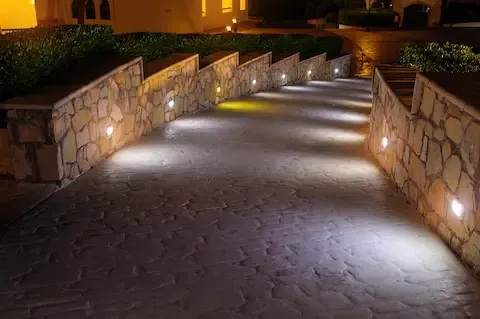
What Voltage for Outdoor Lighting in Sunrise Manor NV
Most outdoor lighting in Sunrise Manor, NV runs on 12-volt low-voltage systems. These are the standard for path lights, accent lights, and landscape uplighting. They are safe, energy-efficient, and easy to expand without an electrician. Security floodlights and hardwired fixtures typically use 120-volt line-voltage power and require a licensed electrician for installation. Choosing the right voltage depends on what you are lighting, how bright it needs to be, and whether you want a DIY-friendly system or a permanent hardwired setup.
What Is the Most Common Voltage for Outdoor Landscape Lighting?
The most common voltage for outdoor landscape lighting in Sunrise Manor is 12 volts. Low-voltage systems use a plug-in transformer that steps household current down from 120 volts to 12 volts. This makes the wiring safe to handle, easy to bury at shallow depths, and simple to modify as your yard evolves. Most homeowners in the area use 12-volt systems for path lighting along driveways and walkways, uplighting on desert plants and palms, and accent lighting around patios and rock features. If you are considering a new setup, check out Outdoor Lighting services to get a professional assessment of your yard's layout and wiring needs.
When Should You Use 120-Volt Line-Voltage Outdoor Lighting?
Line-voltage lighting at 120 volts is the right choice when you need high-intensity illumination for security, large open areas, or permanent hardwired fixtures. In Sunrise Manor, this typically applies to security floodlights mounted on the eaves or garage, post lights at the end of long driveways, and fixtures connected directly to a breaker panel. These installations require a licensed electrician and must meet Clark County code requirements. The wiring must be buried deeper than low-voltage cable and protected by conduit in many situations. The payoff is reliability and brightness that low-voltage systems cannot always match at scale.
What Are the Advantages of Low-Voltage Systems in the Desert Climate?
Sunrise Manor sits in the Mojave Desert, where summer temperatures exceed 110 degrees and UV exposure is intense. Low-voltage LED fixtures handle this environment well. They run cool, consume minimal power, and the 12-volt current is gentle on wiring insulation even when ground temperatures spike. The transformer can be programmed with timers and photocells so lights activate automatically at dusk without running unnecessarily during the peak heat of summer afternoons. Because the cable is thin and flexible, installation does not disturb established desert landscaping, caliche soil layers, or existing irrigation lines the way deeper trench work might.
How Many Watts Can a Low-Voltage Transformer Handle?
Standard residential low-voltage transformers are rated between 150 and 600 watts. Each fixture on the system draws a set wattage, and the total load across all fixtures must stay under the transformer's rated capacity. Most LED path lights draw 3 to 5 watts each, so a 300-watt transformer can comfortably run 40 or more fixtures with headroom to spare. If you plan to add uplighting for large saguaro or mesquite trees, those fixtures may draw 10 to 20 watts depending on the beam spread and lumen output. Always size your transformer with room to grow rather than running it near maximum load, which shortens its lifespan in the desert heat.
Does Wire Length Affect Voltage for Landscape Lighting?
Yes, and this is one of the most common problems in DIY landscape lighting installs across Sunrise Manor. As current travels through cable, it loses voltage due to resistance in the wire. This is called voltage drop. A fixture at the end of a 100-foot run may receive only 10.5 volts instead of 12 volts, causing the bulb to appear dimmer or flicker. To compensate, use thicker gauge wire on long runs, loop the cable in a daisy chain rather than a single straight run, or use a transformer with multiple taps rated at different output voltages. For yards with complex layouts, read our outdoor lighting piece for guidance on wiring configurations that reduce voltage drop across large properties.
Are Solar-Powered Lights a Viable Voltage-Free Option in Sunrise Manor?
Solar lights operate on stored battery power charged by a small photovoltaic panel and do not connect to your home's electrical system at all. In Sunrise Manor, the solar resource is exceptional, with over 290 sunny days per year on average. This makes solar path lights and accent lights a genuinely effective option for areas far from power sources or where trenching is not practical. The limitation is brightness. Solar fixtures typically produce 10 to 50 lumens, which is suitable for marking paths but insufficient for security lighting or uplighting large trees. For decorative border lighting or accent use along a gravel path, solar is a low-maintenance and cost-effective choice.
What Voltage Do Most Professionals Recommend for New Installations?
For most residential properties in Sunrise Manor, landscape lighting professionals recommend starting with a 12-volt low-voltage system for decorative and path applications, then adding a 120-volt line-voltage circuit for any security or high-brightness needs. This hybrid approach gives you flexibility, safety, and the right tool for each use case. The low-voltage portion can be expanded over time without electrical permits. The line-voltage portion is installed once by a licensed electrician and left in place. Planning both into the initial design avoids costly retrofits later and ensures your yard is lit safely and effectively through every season.
