Solar Landscape Lighting for Sunrise Manor NV Yards
Sunrise Manor sits in one of the sunniest corners of Clark County, where rooftops and driveways soak up more than 300 days of direct sunlight every year. That abundance is exactly why solar landscape lighting makes practical sense here in a way it simply does not in cloudier parts of the country. Instead of paying an electrician to trench conduit across caliche soil and run line voltage to every path light and garden fixture, you can let the Mojave sun charge those fixtures for free each afternoon and let them glow through the evening on stored power alone. Done well, solar lighting improves safety, curb appeal, and the usability of your outdoor space without adding a dollar to your electricity bill.
Why Sunrise Manor's Climate Is Ideal for Solar Landscape Lighting
The Clark County average of roughly 294 sunny days per year is a conservative figure for Sunrise Manor specifically. The community sits east of the Las Vegas Strip on slightly higher terrain, and afternoon cloud cover is less frequent here than in some of the valley's lower pockets. What that means practically is that a quality solar panel — typically monocrystalline silicon rated somewhere between 3.5 and 6 watts — will reach full charge on most days between May and October with several hours to spare.
Summer heat is the one complication worth understanding. When ambient temperatures push past 105°F and panel surfaces can exceed 140°F, photovoltaic efficiency does drop slightly. Quality panels lose roughly 0.4 percent of output per degree Celsius above their rated temperature. For a panel operating at 60°C surface temperature instead of 25°C, that is a real but manageable reduction. The practical answer is to look for fixtures that pair a slightly oversized panel with a lithium iron phosphate (LiFePO4) battery rather than the older nickel-metal hydride cells, because LiFePO4 chemistry handles heat cycles dramatically better and retains capacity through far more charge-discharge cycles.
Light Types That Perform Well in Desert Yards
Not every solar fixture sold at a national hardware chain is built for Mojave conditions. Sunrise Manor homeowners should evaluate products on four factors: panel efficiency in high heat, battery chemistry, IP rating, and fixture material.
Path lights: Low-profile stake lights with a frosted lens work well along gravel walkways and decomposed granite borders. Look for an IP65 or higher rating, which means the fixture is fully dust-tight — critical during the gusty spring months when fine Mojave dust coats every surface in the neighborhood.
Spotlights and uplights: Adjustable solar spotlights can highlight a mature desert willow, a boulder accent, or the architectural details on a stucco facade. Two-piece designs that separate the panel from the fixture head give you flexibility to angle the panel south while pointing the light wherever the landscape needs it.
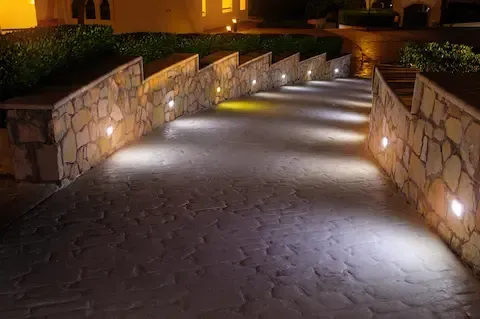
Step and riser lights: Block-mounted solar step lights are genuinely useful on the low block walls and raised planter edges common in Sunrise Manor yards. Recessed designs protect the lens from direct sun exposure during the day, which reduces lens yellowing over time.
String and bistro lights: For covered patios and pergola areas, solar string lights with a remote panel mounted on a south-facing post can illuminate an entertaining space without any wiring at all.
Avoid fixtures with plastic housings that are not UV-stabilized. In the Las Vegas valley, UV degradation turns clear plastic amber within one or two summers, cutting light output and looking shabby. Cast aluminum and stainless steel housings hold up far longer in this climate.
Placement Strategy for Maximum Charge and Coverage
Placement in a Sunrise Manor yard involves two separate decisions: where the fixture needs to cast light, and where the panel can collect sun. In an integrated fixture, those two locations are the same, so you need spots that get full southern exposure without shade from block walls, oleander hedges, or roof overhangs between roughly 9 a.m. and 3 p.m. In a split-panel fixture, you have much more freedom.
A common mistake is mounting path lights under the canopy of a citrus tree or under the eave of a porch overhang where the panel gets only two or three hours of direct sun. Those fixtures charge partially, run at half brightness, and shut off before midnight. Move the panel even a few feet into open sky and runtime improves dramatically.
For a typical Sunrise Manor front yard — roughly 800 to 1,200 square feet of hardscape and desert plant material — a reasonable lighting plan might include four to six path lights along the driveway approach, two spotlights on anchor plants or a boulder feature, and one or two step lights on any raised entry platform. That coverage creates visual depth at night, makes the address clearly visible, and lets residents and guests move safely without any tripping hazards.
Seasonal Adjustment and Maintenance
Solar fixtures in Sunrise Manor need very little maintenance, but they do need some. Dust accumulation on panels is the number one performance killer. During windy spring months, panels can lose 15 to 25 percent of their charging capacity under a layer of fine Clark County dust. A quick wipe with a damp cloth every few weeks keeps output where it should be.
Panel angle matters more in winter. The sun sits much lower in the southern sky between November and February, and a panel tilted at a fixed angle optimized for summer will collect noticeably less energy. Some adjustable-mount fixtures let you tilt the panel more steeply in winter, which partially compensates for the shorter days and lower sun angle.
Battery replacement is the other maintenance item. Even high-quality LiFePO4 cells degrade after 1,500 to 2,000 charge cycles, which at one cycle per day works out to roughly four to five years. Many fixtures use standard 18650 or AA-format rechargeable cells that are easy and inexpensive to swap when runtime begins to shorten noticeably.
Where Solar Lighting Has Limits
Solar is not the right answer for every lighting application in a Sunrise Manor yard. Security floodlights that need to run at 1,500 lumens or more all night, landscape lighting for large trees that require a 20-watt equivalent uplight, and any application where consistent all-night runtime is non-negotiable may still be better served by low-voltage line systems. For those situations, combining a modest line-voltage backbone for the high-demand fixtures with solar for path and accent lighting often gives the best balance of performance and operating cost.
For a comprehensive look at how solar fits within a broader lighting strategy, the outdoor lighting overview covers the full range of fixture types, voltage options, and design approaches used in Clark County yards.
Working with a Local Landscaping Professional
The difference between a solar lighting installation that looks polished and one that looks like an afterthought usually comes down to fixture selection and placement planning before a single stake goes in the ground. A landscaper familiar with Sunrise Manor yards understands the specific soil conditions — particularly the hardpan caliche layers that make stake installation harder than it looks — and can recommend fixture lines that have proven track records in this specific climate rather than in the mild coastal conditions where most product reviews are written.
If you are ready to plan a solar or low-voltage lighting layout for your yard, Outdoor Lighting services from a local professional can help you choose fixtures, map placement, and get everything installed correctly the first time.
Sunrise Manor's combination of abundant sunshine, manageable winter temperatures, and a strong outdoor living culture makes it genuinely one of the best environments in Nevada to get full value from a solar landscape lighting investment. With the right fixture choices and a thoughtful placement plan, you can light a yard that looks great, functions safely, and costs almost nothing to run year after year.
