Monsoon Tree Storm Prep for Sunrise Manor NV Backyards
Monsoon season in Sunrise Manor doesn't ease in gently. By mid-July, the valley floor is pulling desert thunderstorms off the Spring Mountains, and when those cells collapse into straight-line winds, gusts can hit 60 to 70 miles per hour with almost no warning. For homeowners along Nellis Boulevard or tucked into neighborhoods east of Lamb, the difference between a tree that survives that wall of wind and one that ends up through a fence or a car often comes down to preparation done weeks earlier.
Why the Mojave Monsoon Is Different From Rain-Season Wind Elsewhere
Most regions get wind with their storms, but the Mojave delivers a specific hazard called a haboob — a collapsing thunderstorm outflow that hits as a solid wall of dust and turbulence moving faster than most gusts from a tropical storm. What makes it punishing for trees is the combination of factors hitting simultaneously: saturated soil from the rain that precedes or follows the outflow, a dense canopy acting as a wind sail, and root systems already stressed from months of summer heat and minimal deep watering. The tree that looked stable in June becomes a lever with a wet fulcrum at exactly the moment the wind pushes hardest.
Which Trees in Sunrise Manor Carry the Most Storm Risk
Mature Mexican fan palms with skirts of dead fronds are the most commonly damaged trees after a monsoon event in this area. Each skirt frond adds sail area and acts like a parachute when wind hits from an unexpected angle. Overgrown mesquites are the second most frequent problem — their dense canopy is beautiful shade cover in spring but turns into a solid wind wall by July. African sumac, Texas rangers grown into full-size shrubs, and any tree planted close to a wall with a root system compromised by concrete or caliche are all elevated risks. If you are unsure how your trees rank, the tree trimming overview covers species-specific considerations in more detail.
Canopy Reduction: The Single Most Effective Preparation Step
Thinning a canopy before the monsoon reduces wind resistance without sacrificing the shade value or structure of the tree. A well-thinned mesquite allows wind to move through the branch architecture rather than pushing the whole canopy as a unit. The goal is not to scalp the tree — aggressive topping actually creates weaker regrowth points that fail even more easily in subsequent storms. The goal is to open interior space, remove crossing limbs, and trim back any branches that extend far past the natural drip line and act as long levers against the trunk.
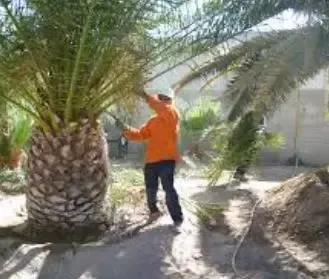
For palms, the prep step is removing dead and dying fronds down to the green live crown. In Sunrise Manor's summer heat, fronds that are more than halfway brown are not recovering. Pulling them before the monsoon eliminates the skirt that catches wind and also removes the harborage that scorpions and roof rats use through the summer months.
Staking Young Trees Before July
If you planted a tree in the fall or winter and it hasn't fully established its root ball, monsoon wind can rock it enough to break the fine feeder roots that are doing the anchoring work underground. A proper two-stake or three-stake setup with wide, flexible ties — not wire through a hose — allows the trunk to flex naturally while preventing the rocking that tears roots. Stakes should be removed after the first full growing season; leaving them longer creates trunk dependency that weakens the tree over time.
The stake positioning matters in Sunrise Manor because the dominant monsoon outflow tends to come from the southwest as the storm collapses. Stakes placed perpendicular to that approach — one to the southwest and one to the northeast — resist the most common wind angle while still allowing the tree to develop trunk taper through normal flex.
Root Zone Watering Strategy Before the Season
A tree with a deeply watered root system anchors better than one with shallow surface roots. In the weeks before monsoon season peaks, deep watering every ten to fourteen days encourages roots to chase moisture downward rather than spreading horizontally just under the mulch layer. A slow trickle at the drip line for several hours achieves this better than a quick overhead spray. Avoid watering the immediate two days before a storm is forecast — the goal is deep anchor roots, not a saturated and loosened soil layer at the surface. Trees are only part of it; the full monsoon prep checklist covers slope erosion, drainage swales, and rock mulch depth for the rest of the yard.
Checking Tie-Downs for Potted Specimens and Structures
Large potted palms and ornamental trees near patios in the Sunrise Manor neighborhoods east of Hollywood Boulevard are a specific hazard when monsoon gusts arrive. A seven-gallon container olive or a forty-gallon potted sago palm can become airborne in a 60 mph outflow. Ground anchors with ratchet straps rated for outdoor use are available at local hardware stores and take about twenty minutes to set up per plant. Patio umbrellas, shade sails, and decorative lattice panels should be secured or removed entirely before the first forecast storm of the season — not the night before.
When to Call a Professional Before the Storm Window
There are situations where pre-monsoon tree work clearly requires a licensed arborist or tree service rather than a homeowner with loppers. Any branch over your roof, over a neighboring structure, or over a utility line is a professional job. Any tree with a trunk diameter above twelve inches requires equipment most homeowners don't have access to. And any tree showing signs of internal decay — hollow sound when knocked, fungal growth at the base, or a visible lean that has developed since last season — needs a professional assessment before the monsoon loads it with wind stress. For Tree Trimming in Sunrise Manor, working with a service that knows local species and the specific storm patterns this area faces is worth scheduling in late May or early June before crews book up for the season.
Closing Perspective
Monsoon preparation is one of those maintenance categories that feels optional until a storm proves it wasn't. In Sunrise Manor, where neighborhoods sit in open desert terrain without the windbreaks that older urban areas often have, trees take the full force of outflow events with nothing to soften the approach. A few hours of canopy work, a check on young tree stakes, and a smart watering schedule in June are all it takes to move your trees from the risk column to the ready column before July arrives.
