HOA Landscape Design Rules in Sunrise Manor NV Tracts
If you own a home in a deed-restricted tract in Sunrise Manor, NV, your landscaping decisions are not entirely your own. Homeowners associations in this part of the Las Vegas Valley have written governing documents that control plant selection, hardscape ratios, ground cover types, and even the color of decorative rock. Understanding those rules before you break ground on a conversion or renovation saves you from correction notices, fines, and the expense of tearing out work you just paid for. This guide walks through the landscape design provisions that appear most commonly in Sunrise Manor HOA tracts and explains what they mean in practical terms for your property.
Why HOA Landscape Rules Exist in Sunrise Manor Tracts
The deed restrictions that govern Sunrise Manor neighborhoods were established largely to maintain consistent curb appeal and to meet Nevada's water conservation goals. Clark County and the Southern Nevada Water Authority have pushed hard for turf removal and drought-tolerant conversions, and many local HOA documents have been updated over the past decade to align with those mandates. The result is a layered system: state conservation guidelines set a floor, your HOA's CC&Rs sit on top of that, and your specific tract may have an additional architectural review process that evaluates individual submissions against a defined plant palette or design standard.
The practical effect is that even a well-intentioned desert conversion can be rejected if it uses unapproved ground cover, places boulders in prohibited zones, or fails to meet minimum plant spacing requirements written into your association's rules. Knowing the framework before you design protects your investment.
The Most Common Restrictions Sunrise Manor HOAs Impose
While CC&Rs vary by tract, several categories of restrictions appear consistently across Sunrise Manor HOA communities. Reviewing these gives you a working checklist before you submit any plans for architectural approval.
Approved plant palettes: Many associations maintain a list of acceptable desert-adapted species. Mesquite, desert willow, Texas sage, red yucca, and bougainvillea appear on most approved lists. Non-native species with high water demand are routinely excluded.
Ground cover minimums: Some governing documents require that a specified percentage of the lot's front yard surface area be covered by decomposed granite, river rock, or approved mulch. Bare soil and exposed irrigation lines are typically prohibited.
Turf restrictions: HOAs that adopted updates aligned with the SNWA turf replacement program often limit or prohibit Kentucky bluegrass, Bermuda grass, and fescue in front yards. Some allow a small amount of synthetic turf if installed to grade with a natural-looking infill.
Hardscape ratios: Architectural review committees in several Sunrise Manor tracts cap the percentage of the front yard that can consist of poured concrete, pavers, or flagstone. A common limit is 50 percent, though some tracts set this lower.
Rock color and size: Decorative rock must often match samples pre-approved by the association. Large whitewashed river rock, for example, is prohibited in certain tracts while neutral-toned decomposed granite in quarter-minus or half-inch grade is standard.
Tree placement: Canopy trees must sometimes be planted in designated front-yard zones, set back from sidewalks and utility easements by distances specified in the governing documents.
Reading Your CC&Rs Before You Design
The most important step before any landscape project in a Sunrise Manor HOA tract is pulling the actual governing documents. Your CC&Rs, bylaws, and any architectural guidelines addendum are typically recorded with Clark County and available through the county recorder's office. Your HOA management company is required under Nevada law to provide copies to homeowners on request. Read the landscaping section in full, not just the summary sheet sometimes distributed at move-in.
Pay attention to any amendment dates. Many Sunrise Manor associations updated their landscape sections between 2020 and 2023 in response to Nevada's Commercial and Ornamental Turf Replacement Program. A document that was current when you bought your home may have been amended since. Confirm you are reading the most recent recorded version before you finalize your design.
Once you understand your association's standards, work through the front yard plan writeup to see how site-specific considerations translate into a finished design that supports the submission package your HOA's architectural committee will review.
The Architectural Review Submission Process
Most Sunrise Manor HOAs require written approval before any significant landscape modification begins. Submitting without approval is one of the fastest ways to receive a violation notice and a mandatory removal order. The submission package typically includes a scaled plot plan showing plant locations, a plant list with species names and container sizes, a description of ground cover type and depth, and sometimes a photograph of similar installed work or manufacturer cut sheets for any hardscape materials.
Review periods in most Sunrise Manor associations run 30 days from receipt of a complete package. Some governing documents state that silence after that period constitutes approval, but do not rely on that provision without confirming it in writing. Submit early enough to leave time for a resubmission if the committee requests changes.
Practical Design Approaches That Tend to Gain Approval
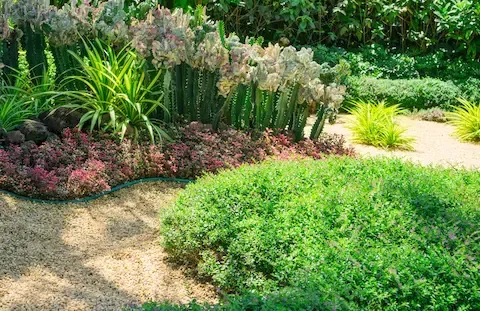
Designs that mirror the aesthetic of already-approved front yards in your tract move through architectural review faster. Desert-adaptive Landscape Design that pairs a canopy tree such as a multi-trunk desert willow with mid-height shrubs like desert ruellia, two to three accent agaves, and a ground cover of decomposed granite in a tan or rust tone meets the plant and material standards of most Sunrise Manor associations without triggering any of the common rejection reasons.
Spacing matters as much as species selection. Plant material submitted at proper mature-size spacing looks sparse at installation but satisfies the CC&R requirement that neighbors' sightlines and shared easements remain unobstructed. Proposing plants at smaller spacing to achieve a fuller initial look is a common reason for rejection or a modification request.
When Your HOA's Rules Conflict with SNWA Incentives
Nevada homeowners who participate in the SNWA turf removal rebate program sometimes discover that their HOA's CC&Rs require a minimum amount of turf in front yards — a holdover provision from documents drafted before the state's conservation push. Nevada law has addressed this conflict. Under NRS 116.2111, an HOA may not enforce a provision that prohibits or unreasonably restricts water-efficient landscaping. If your Sunrise Manor HOA attempts to require turf in a front yard as a condition of architectural approval, that provision is not enforceable. Document the exchange in writing and reference the statute if needed.
The reverse situation also arises: homeowners who want to install synthetic turf find that many associations in Sunrise Manor specifically prohibit it or require it to meet a detailed appearance standard. That restriction is generally enforceable unless the synthetic product qualifies as water-efficient landscaping under the state's definition, which is a narrower category than most homeowners assume.
Working with a Landscaper Who Knows Local HOA Requirements
Selecting a landscape contractor familiar with Sunrise Manor HOA submission processes reduces your project's risk substantially. A contractor who has submitted approved packages to your association — or to similar ones in the Clark County area — already knows which plant species clear the approved palette, which rock products match the pre-approved samples on file, and how to format a plot plan in a way the review committee accepts without correction requests. That knowledge shortens the approval timeline and reduces the likelihood of a post-installation violation.
Ask prospective contractors whether they have submitted to HOA architectural review committees in Sunrise Manor or the broader Las Vegas Valley. Request examples of approved submissions if available. Landscape design in a deed-restricted community is a different scope of work than an unrestricted residential project, and the contractor's process should reflect that distinction from the design phase forward.
